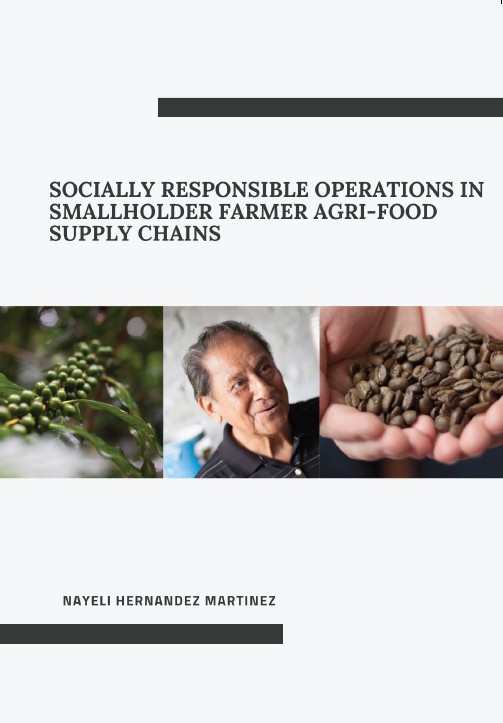
This thesis focuses on understanding the impacts of including social objectives in decision-making in Operations Management. In particular, we consider agri-food supply chains in the context of developing countries, where the economy relies highly on agriculture and yet, farmers often live in poverty conditions.
Based on the real case of Mexican company Fractal Café, we study how the introduction of equity concerns affects the pricing and investment decisions of a farmer and a buyer. We propose a sequential game theoretic model and find that the introduction of equity concerns leads to a redistribution of the profit towards a more equitable outcome. However, the investment decisions follow a different structure: the player who acts as game leader finds it optimal not to make an investment, leaving the game follower as the only investor. Furthermore, we study the effects of introducing stakeholder engagement in this problem context, together with the equity concerns. We find that this practice is not beneficial for the farmers, as their utilities and profits are higher when they act as game followers.
We also study the real case of the FairChain Foundation in the Netherlands, which collaborates with companies such as Moyee Coffee. They purchase coffee from Ethiopian farmers and are committed to help improve their living conditions by paying premiums, directly or in the form of training, for high quality coffee, and offering transportation solutions for the farmers who need to travel long distances. Aside from their already complex conditions as smallholder farmers in a developing country, Ethiopian farmers face the additional challenge of dealing with the natural phenomenon of alternate bearing. This phenomenon significantly decreases the coffee yield on what is known as low-yield years, but their occurrence is unpredictable. This results in highly variable incomes for the farmers, as they don’t have much coffee to sell during low-yield years. Using a system dynamics model, we study the dynamics present in a context like the one in which Ethiopian farmers operate, and how these affect the outcomes of socially responsible initiatives. We find that the benefits of the premiums are maximized when they are allocated to the organization of trainings for farmers in anticipation of low-yield years, which translate into higher yields and better quality coffee in subsequent years. In addition, the right balance between the investment in said trainings and in transportation must be achieved, otherwise the farmers will sell their improved outputs in the market, rather than to FairChain. We also find the investment on FairChain’s initiatives needs to be significantly high to reduce the high variability in farmers’ income between high and low-yield years.
Continuing with the case of FairChain and Moyee coffee, we look closely into how the farmers decide if they will sell their harvested coffee to FairChain or at the market. Modelled as a strategic game where the farmers seek to maximize their profit, we identify under which conditions the farmers find it optimal to sell to FairChain. This allows us to identify how the premiums paid directly to farmers must be designed to guarantee that the farmers will choose to sell to FairChain.
The cases studied in this thesis allow us to recognize the importance of introducing social objectives in decision-making in Operations Management. We identify conditions under which such practices are beneficial not only for the farmers, but also for the companies that promote them. Furthermore, we find that the sole investment in socially responsible practices is in many cases insufficient, as these initiatives need to be carefully tailored to guarantee not only that they will yield benefits, but also that they can be sustained in the long-term.